
The Viral Confusion: Are All Frames Banned?
The Florida automotive community has been in a state of high alert. Since the passing of House Bill 253, social media has been flooded with “emergency alerts” claiming that any license plate frame that touches a letter or a slogan is now a criminal offense. This has led to thousands of drivers in Central Florida stripping their vehicles of custom accessories in fear of heavy fines or even arrest.
As experts at MFG:Dreams with over 20 years of experience in the local scene, we’ve analyzed the legislative text of the new bill and the corresponding updates to Florida Statute 320.262. The reality is far less scary than the headlines, but there are specific rules you must follow to stay compliant.

The “Primary Features” Test: What You Can and Can’t Cover
To understand if your frame is legal, you have to look at what the Florida Department of Highway Safety and Motor Vehicles (FLHSMV) defines as “Primary Features.” If your frame covers any of these three elements, you are in violation of Florida Statute 320.061:
- The Alphanumeric Identifier: Your actual license plate number (e.g., ABC 123). No part of these characters can be obscured.
- The Validation Decal: This is the most common point of failure. The registration sticker (showing the month/year) in the top right corner must be 100% visible. If your frame overlaps even the edge of that sticker, it is an illegal obstruction.
- The State Name: The word “Florida” at the top must be clearly identifiable.
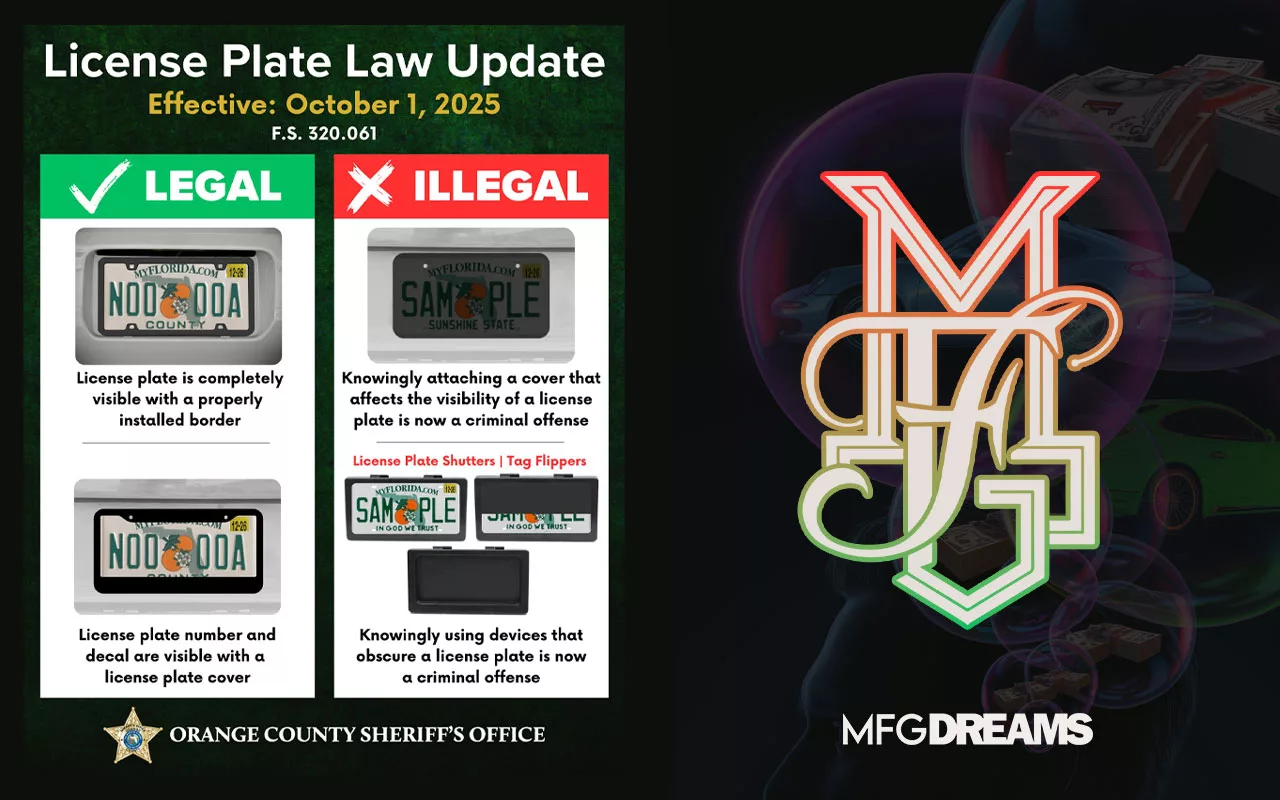
Visual Guide: Analyzing the Orange County Sheriff’s Guidance
To clear up the confusion, the Orange County Sheriff’s Office (OCSO) recently released a visual guide to help Central Florida drivers distinguish between a legal accessory and an illegal obstruction. This guidance is critical for anyone driving through Orlando, Winter Park, or Lake Nona.
As seen in the OCSO guidance, the “OK” examples show frames that are slim enough to keep the top-right registration decal and the main plate numbers completely unobstructed. The “NOT OK” examples focus on:
- Frames that are too thick and cut off the top of the word “Florida.”
- Covers that have a tint, smoke, or “bubble” effect.
- Frames that overlap the validation sticker, making the expiration date impossible to read for a following officer or a toll camera.
The OCSO emphasizes that while slogans like “Sunshine State” or “In God We Trust” at the bottom are frequently covered by frames, the primary focus for enforcement is the decal and the alphanumeric characters.
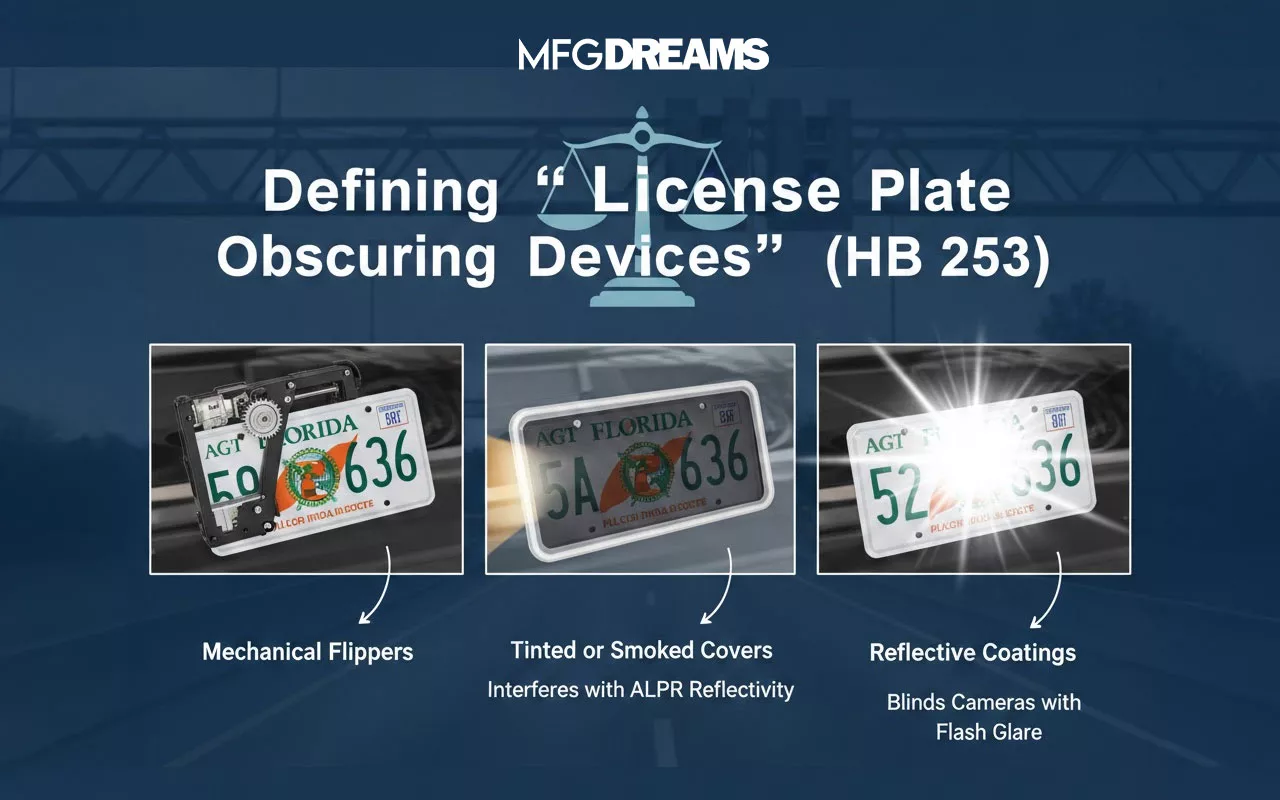
Defining “License Plate Obscuring Devices” (HB 253)
The core of the new legislation focuses on Statute 320.262. This is where the law moves from simple traffic infractions to potential criminal charges. The law defines an “obscuring device” as any physical, electronic, or chemical tool that intentionally prevents a plate from being read.
This includes:
- Mechanical Flippers: Devices that rotate the plate to hide the vehicle’s identity.
- Tinted or Smoked Covers: Even “light” tints are now high-risk, as they interfere with the reflectivity required for Automated License Plate Readers (ALPR) used on Florida tolls.
- Reflective Coatings: Sprays or films designed to “blind” cameras with a flash glare.
The Penalty Breakdown: Infractions vs. Felonies
Understanding the stakes is vital for every Central Florida driver. The penalties are tiered based on intent:
| Violation Type | Legal Classification | Typical Penalty |
|---|---|---|
| Obscured Decal or Letter (Standard Frame) | Non-Criminal Traffic Infraction | $100 – $160 Fine (varies by county) |
| Possession of a Flipper/Obscuring Device | Second-Degree Misdemeanor | Up to 60 days in jail / $500 fine |
| Use of Device to Commit a Crime (e.g. Toll Evasion) | Third-Degree Felony | Up to 5 years in prison / $5,000 fine |
Central Florida Compliance Checklist
To keep your car looking MFG:Dreams quality without attracting a flashing blue light on the I-4 or 408, follow this checklist:
- Check the 4 Corners: Ensure your frame does not touch the edges of your yellow or green registration decal.
- Ditch the Plastic: Even “clear” covers can catch glare and give an officer probable cause for a stop. In Florida, no cover is the safest cover.
- The 50-Foot Rule: If you cannot clearly distinguish every letter and the state name from 50 feet away at a slight angle, your frame is likely illegal.
#TheMoreYouKnow #MFGDREAMS
Share this on your favorite social network with the icons below!